
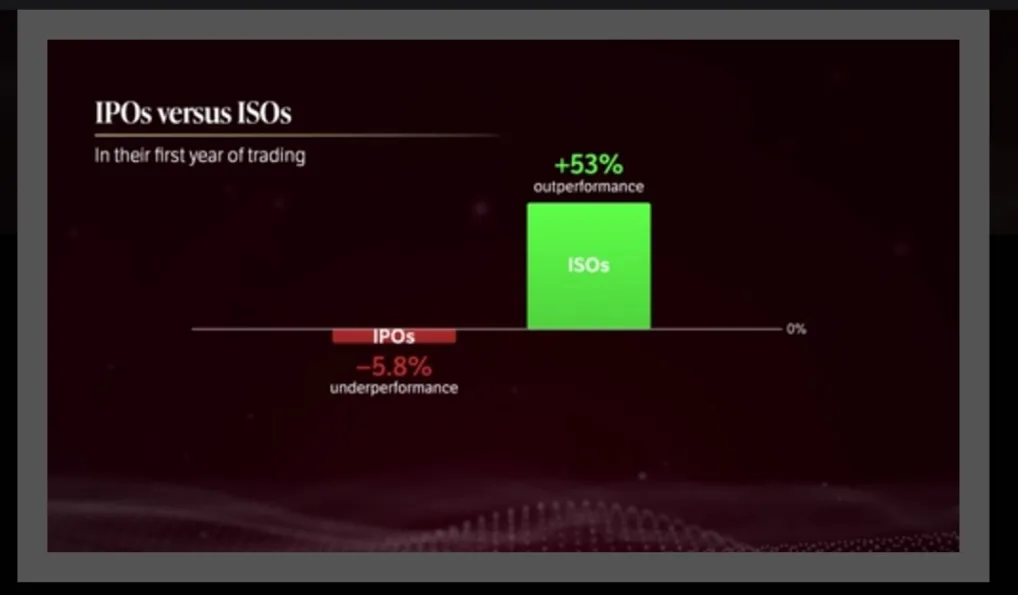
Stansberry Research lead analyst Gabe Marshank says most initial public offerings (IPOs) underperform the market.
He has the numbers to back it up and also presents a better alternative in the form of an “Ultimate ISO” Stock, that Wall Street doesn’t want you to know about.
The Teaser
Just as the major IPO wave comes to a close, the ISO flood is picking up steam.
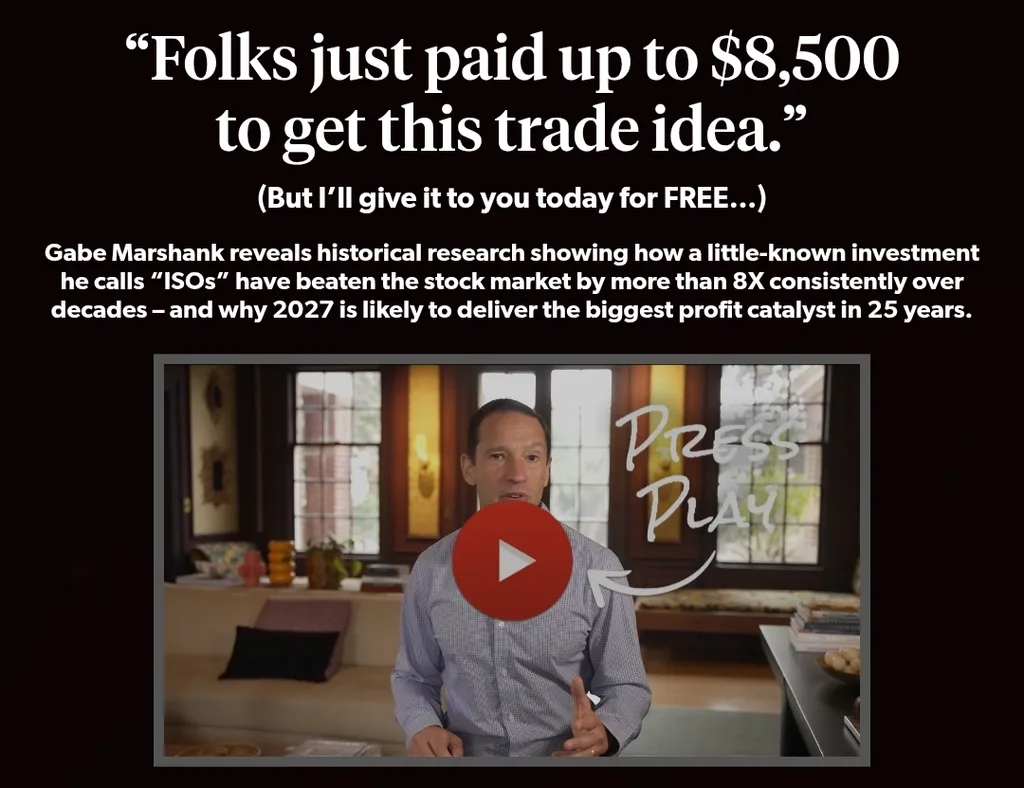
Gabe is a 20-year veteran of “the street,” having worked at such storied hedge funds as David Einhorn’s Greenlight Capital and Steven Cohen’s S.A.C. Capital, among others.
At Stansberry, whose investment teasers we are intimately familar with, having reviewed their Big Lie Behind America’s Economy and Self-Driving Car Company to 10x Your Money teasers, Gabe focuses on finding asymmetric risk/reward opportunities in the stock market.
To prove this asymmetry of which he speaks, Gabe pulls up a handy chart showing the difference between new IPOs and what he calls “ISOs.”
But it’s not just IPOs that “ISOs” have outperformed. They have also trounced the S&P 500 over multi-year periods:
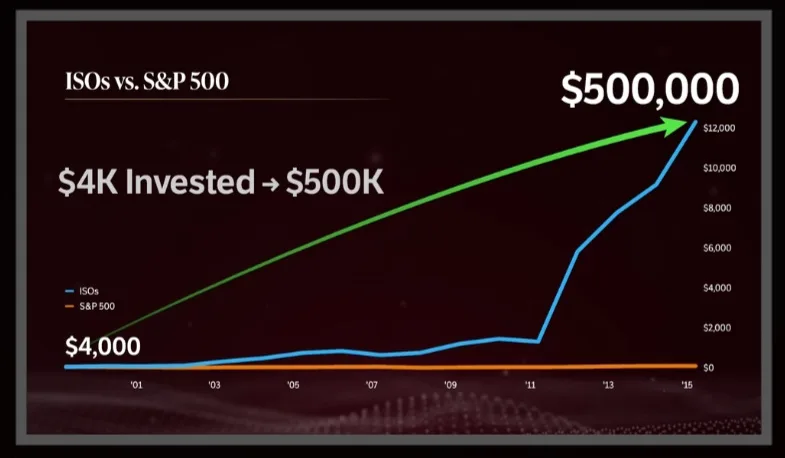
Putting their outperformance on par with the likes of this decade’s best individual stocks like Nvidia and Amazon.
Warren Buffett is even a proponent of ISOs, saying:
The category produces more steady absolute profit from year to year than most investments
Being familiar with most of Warren’s Berkshire annual letters and interviews, it sounds like Gabe is teasing spin-off investing.
My spidey-senses were proven right this time around, with Gabe admitting that his introduction to ISOs came in the late 90s, when Dun & Bradstreet began spinning-off it’s various operating businesses, including Cognizant Technology Solutions (Nasdaq: CTSH), which went on to return a whopping 40x.
This taught Gabe an important lesson, that not all spin-offs are created equal, and that there is a framework to identify an “Ultimate ISO” from a regular one.
The Pitch
Gabe’s setup and the name of a spin-off that checks off every one of his factors is made available to us in a memo titled “The Ultimate ISO.”
The memo is only available to subscribers of Gabe’s new research service, Market Maven, which is one of Stansberry Research’s most pricey offerings at an introductory price of $2,500 for a full year (normally $10,000).
What Makes “ISO” Spin-offs Better Than Others
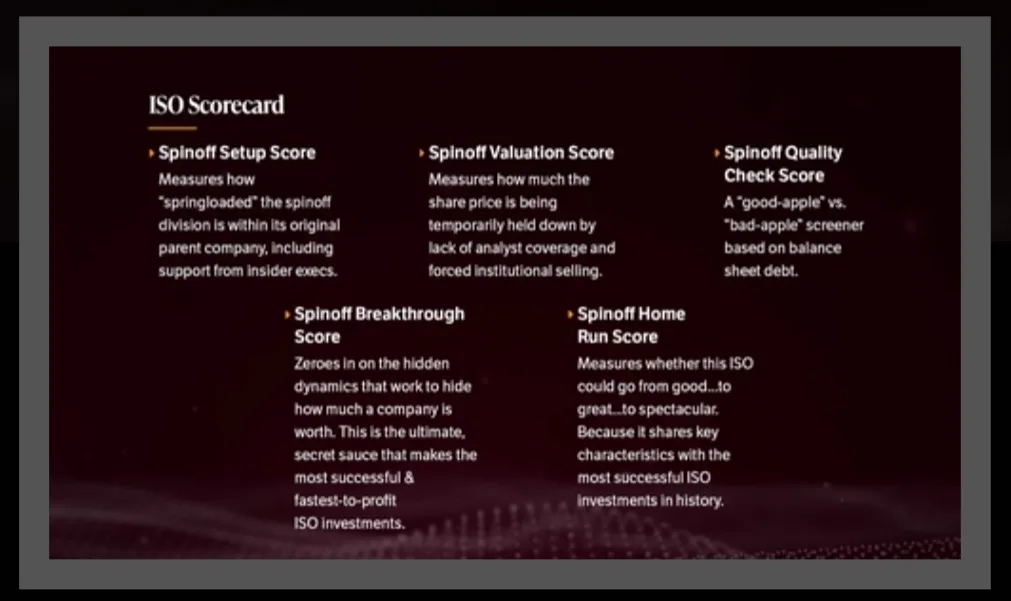
We didn’t expect Gabe to disclose the secret sauce behind his five-factor investable spin-off (ISO) scorecard, especially not after learning the price of his research service.
But we did listen to his entire nearly hour-long video presentation to get some insight and in the end, we weren’t totally disappointed.
Besides CEOs who have bought one too many businesses and the market telling them to sell some, one of the first things Gabe looks for from businesses being spun-out of larger concerns is index exclusion, which is part of his setup score.
Almost every spin-off is a stock that index funds are mandated to sell due to their investment charters precluding them from owning non-index stocks. Such artificial selling acts like a mattress springcoil, with stocks almost immediately bouncing back once the selling pressure subsides.
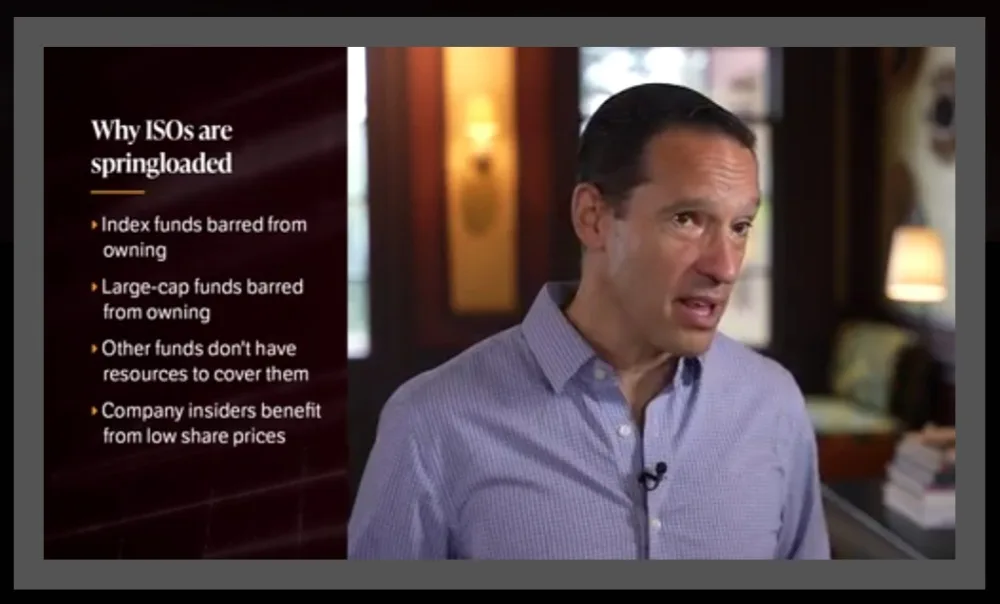
Something else on Gabe’s checklist is a lack analyst coverage.
The more under-the-radar a spin-off is, the more likely it is to not be overbought, unlike high-profile IPOs such as SpaceX and the upcoming Anthropic listing. Spin-offs in unloved industries like industrials and consumer staples/discretionary offer up such opportunities.
These are some of the setup and valuation criteria that make up Gabe’s overall ISO scorecard:
It’s hard to argue with the results:
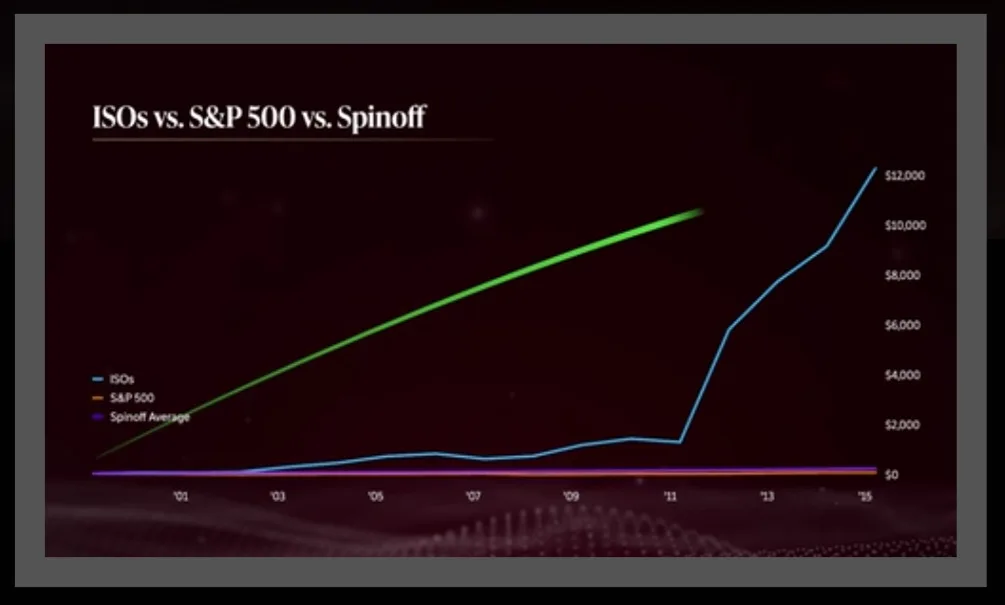
The number of S&P 500 companies spinning-off subsidiaries is near a decade high and when coupled with Gabe’s ISO scorecard, the setup for triple digit, or higher, gains is here.
Now, Gabe has his sights set on an “Ultimate ISO” that scores high on each one of his five criteria.
Revealing Gabe Marshank’s “Ultimate ISO” Stock
Around the 42-minute mark of the teaser, Gabe got down to business and shed some light on the investable spin-off in his sights.
- The company controls the chemical that’s used to make the world’s most advanced silicon computer chips.
- It recently signed a licensing deal with the U.S.Department of Energy (DOE) that runs all the way through the year 2060.
Based on the clues, this sounds like Solstice Advanced Materials Inc. (Nasdaq: SOLS), which was spun out of Honeywell International in late 2025.
- Solstice supplies Spin-on Glass, which is a precursor chemical applied to silicon wafer chips for insulation and other purposes.
- It did receive a grant from the DOE and also holds a license to operate its Metropolis Works uranium-conversion facility until 2060.
18 Years Worth of Nvidia Returns in 18 Months?
As Joel Greenblatt once eloquently put it…
You can make a pile of money investing in spin-offs
This is true regardless of whether the market is up, down, or treading water.
The numbers bear this out, with U.S. spin-offs historically outperforming the S&P 500 by an average of 13.4% in their first year.
I myself am a beneficiary of a Seabridge Gold (NYSE: SA) spin-off, Valor Gold Corp. (OTC: VLGDF), receiving one common share for every 1.95 shares of SA stock I own. The spin-off stock is up more than 65% year-to-date and was up even more at one point.

This was some accidental alpha from a stock purchased as a long-term hold, but it backs up Gabe’s ISO thesis.
However, as a word of warning, spin-offs or “workouts,” as Ben Graham called them, are more of an active investing strategy, not a passive set it and forget it one.
That said, there are a few keys to investing in special situations (spin-offs).
It starts with being aware of who is spinning off what (announced spin-offs). There are dedicated websites tracking this.
Next comes knowing the terms of the deal, how many shares you’re getting, when the distribution will happen, and what assets will be included. In effect, enough information to make an informed decision about whether you are receiving more value than the price on the date of the announcement.
As a rule, the shorter the holding period, the higher the expected return, and the less inherent risk there is in owning the parent company stock, the better.
Honeywell shareholders who received Solstice shares have so far been rewarded with a return of more than 20%, which is far from Nvidia-worthy, but it’s a start, and the kind of returns Gabe teases are definitely possible with a diversified basket of spin-offs.
Quick Recap & Conclusion
- Stansberry Research lead analyst Gabe Marshank is teasing an alternative investment in the form of an “Ultimate ISO” Stock.
- “ISO” stands for Investable Spin-Offs and Gabe has developed a proprietary five-factor ISO scorecard to identify and profit from such special situations.
- The name of a spin-off that checks off all five factors is revealed in a memo titled “The Ultimate ISO.” It’s only available to subscribers of Gabe’s new research service, Market Maven, which starts at an introductory price of $2,500 for a full year (normally $10,000).
- Solstice Advanced Materials Inc. (Nasdaq: SOLS), which was spun out of Honeywell International, sounds like Gabe’s “Ultimate ISO.”
- A diversified basket of well-selected spin-offs can produce above-average returns.
Have you ever been gifted or invested in a spin-off? Tell us about your experience in the comments.