
The biggest wealth building opportunity since the release of generative artificial intelligence.
This is how Jeff Brown describes “Orbital AI“, and the way he sees it, one under-the-radar chipmaker stock will be like knowing about Nvidia before 2020.
The Teaser
There’s one man that could win a virtual monopoly on this new breakthrough technology and his name is…Elon Musk.
Longtime tech investor Jeff Brown has spent much of the year researching and writing about the public filings giving insight into “Orbital AI“. We have covered some of his previous deep dives, including his and Jason Bodner’s Secret AI Stocks and Medical Holy Grail, among others.
The documents Jeff has been pouring over are SpaceX Federal Communications Commission (FCC) filings, which by law, it is required to make as a business that sells electronic and radio-frequency devices domestically in the U.S.
These standard, run-of-the-mill government disclosures are typically dryer than the sahara desert, but buried deep inside one SpaceX FCC filing, Jeff discovered something startling.
The Real Reason for the Largest Merger in History
This past February a $1.25 trillion merger was completed.
xAI, with a value of $250 billion at the time was absorbed into the $1 trillion tenner unicorn that is SpaceX.
Many dismissed it as Elon Musk giving himself a big hug, but what they missed is the vertical integration of the emerging space economy.
What Jeff discovered in that faithful FCC filing is an application for something called the “SpaceX Orbital Data Center System.”
Just like it sounds, “Orbital AI” is all about data centers in space.
A little more than a decade ago, this would sound like pure science fiction and a slightly unhinged.
However, given SpaceX’s growing list of accomplishments, like being the first commercial spacecraft to deliver cargo to the International Space Station and the first to land and reuse orbital rockets, it doesn’t sound so far-fetched anymore, and it’s solving three major problems that “Earth-bound AI” cannot.
The Pitch
One company could be the single biggest enabler of “Orbital AI” and it’s name is only revealed inside a report called The Little-Known Chipmaker Enabling The 106X “Orbital AI” Boom.
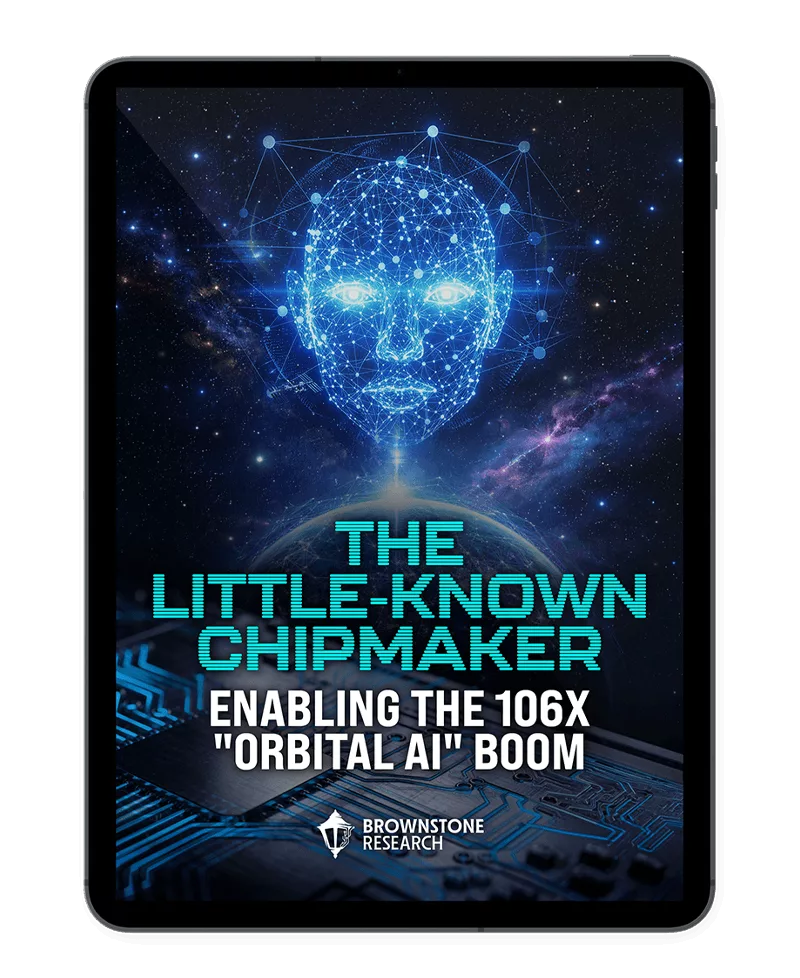
As is standard course, the only way to access it is with a subscription to Jeff’s Near Future Report investment newsletter.
Normally, a 12-month subscription would run us $499, but for a limited time we can get in for $179, with a 30-day money-back guarantee.
The Three Major Problems with AI Data Centers
One man’s problem is another’s opportunity.
This is a universal truth, it’s just that the rewards of solving some are bigger than others.
Fixing the biggest roadblocks to the AI buildout could yield some of the biggest rewards in the market, but the task is daunting.
Out of this World Power Requirements
50x.
This is how much more energy an AI data center uses compared to an average commercial building.
Incredibly, this is just the start.
The energy needs of AI data centers are fully expected to quadruple over the next five years.
This goes beyond just industrial-scale usage to near-impossible consumption.
This is because AI data centers need to either connect to the local energy grid (where possible) or create their own private minigrids just to get online.
Proverbially sticking a data center in space would solve this issue.
Water Usage that Creates Droughts
175 degrees Fahrenheit is the thermal ceiling for AI chips.
Anything hotter than this and hardware simply melts down like a triple-scoop ice cream cone on a hot summer day.
To make sure such a tragedy does not occur, AI data center operators rely on municipal water supplies to the tune of as much as a million gallons per day.
This is consunption is equivalent to a small town of 1,000 people.
Given that 7 out of 10 Americans are already affected by drought conditions, we simply cannot afford to throw out good water after bad.

Costs so high they will make you cry
Between upfront construction cost, power, and maintenance, getting an AI data center up and running costs billions.
As much as $30-40 billion by some estimates.
“Orbital AI” could be the answer to these monumental problems.
By launching and connecting satellites equipped with AI chips and solar panels in space, where the temperature is just a few degrees above freezing, SpaceX hopes to solve the power and water issues plaguing AI data centers back on earth, while being cost competitive.
In case you haven’t heard, SpaceX just went public, but this isn’t where the biggest opportunity is.
Instead, far greater gains are supposed to come from a hidden supplier making “Orbital AI” a reality.
Revealing Jeff Brown’s “Orbital AI” Chipmaker Stock
We already know the company Jeff teases is a chipmaker, but what else do we know about it?
- The company makes something called RadHard (Radiation-Hardened) chips which every space satellite requires.
- It has already shipped five billion chips to SpaceX.
- Not only does it supply SpaceX with RadHard chips, but it also provides it with inter-satellite laser links that connect the orbital satellites.
- This isn’t Nvidia, it’s 148x smaller.
All the clues point to STMicroelectronics N.V. (NYSE: STM) being the pick.
- The Swiss chip manufacturer makes a large assortment of electronic components, including custom satellite chips, microcontrollers, and others.
- It has shipped more than 5 billion radio frequency antenna chips for Starlink satellites.
- Apart from chips, STMicro also supplies Starlink with systems that handle high-speed optical links between satellites.
- STMicro isn’t quite 148x smaller than Nvidia, just 82x based on it’s current market cap of around $60 billion.
Multiply Your Money from the 106x Space Market Explosion?
There are Teslanaires and SpaceXanaires.
But do the biggest gains actually from their suppliers?
In one word, no.
Tesla is one of the best-performing large cap stocks of the past five years.
Excluding Nvidia, another supplier and top performer, the Tesla supplier stocks that have performed the best are Panasonic (OTC: PCRHY) and Amperex Technology Co. (OTC: CYATY) returning more than 150% and 50%, respectively over the past year. Great returns, but not Tesla-ish compounders.
As a fresh new listing, the jury is still out on SpaceX.
Will STMicro be it’s first breakout supplier stock?
In many ways, it already is.
STM has been a pick of several investment newsletter prognosticators and it has delivered. The stock is up more than 160% over the past year.
However, at a forward P/E of 60x, I don’t know how much gas is left in it’s current bull run.
On one hand, the space economy is expected to reach nearly $2 trillion over the next decade. An annual growth rate of 9-10%, which startups, incumbents, and their suppliers will all benefit from.
On the other, continous outperformance by a business with a sub-2% profit margin and a return on equity of less than 1%, is asking a bit much.
I don’t like STMicro at its current market price and don’t think it’s a multi-bagger from here. But I’m keeping an eye on space economy opportunities that could be proverbial rocket ships.
Quick Recap & Conclusion
- Jeff Brown is teasing something called “Orbital AI“, and one under-the-radar chipmaker stock will be like knowing about Nvidia before 2020.
- So-called “Orbital AI” is satellites in space, equipped with AI chips and solar panels, solving the power and water issues plaguing AI data centers back on earth, while being cost competitive.
- One company could be the single biggest enabler of “Orbital AI” and it’s name is only revealed inside a report called The Little-Known Chipmaker Enabling The 106X “Orbital AI” Boom. The only way to access it is with a subscription to Jeff’s Near Future Report investment newsletter, which costs $179 upfront for the first year (normally $499).
- However, you get it here for free! It’s STMicroelectronics N.V. (NYSE: STM).
- STMicro is a confirmed SpaceX supplier with poor underlying economics and a high stock price.
Is “Orbital AI” the solution that will scale to AI’s ambitions? Leave your thoughts in the comments.
Appreciate your free service over the years, at least you deserve *****!!!
I read all your emails with interest. I am 80 and crippled. trying to get savings account money to make a reasonable score and your insights give me a fighting opportunity.
dan anglin