

One stock to fund your retirement.
Jeff Brown called Nvidia back in 2016, which would have turned $5k into more than $1.8 million and now he’s seeing the exact same setup in an “Accelerated AI Stock,” that is the basis of his new one stock retirement plan.
The Teaser
One thousand times the speed of regular artificial intelligence from a “Golden Tablet.”

Former tech executive, investor, and Elon Musk booster Jeff Brown has been one of the most active investment newsletter publishers this year. Releasing teasers about an “Orbital AI” Chipmaker Stock and Quantum Computing Stocks, that we have reviewed.
Host Chris Hurt kicks the presentation off with a flattering introduction of Jeff, who says “Elon Musk has made two genius moves that will turbocharge AI.”
This speaks to the whole ‘1,000x’ing the speed of AI’ in the teaser intro.
The first move is building the world’s largest chip manufacturing facility, Terafab. Construction is set to commence this quarter, with an initial estimated completion date by the end of 2028.
For reference, the proposed facility is so huge that it can fit the U.S. Pentagon and the Mall of America inside of it.

Elon’s second move is even more ambitious.
Through his recently IPO’ed SpaceX, he’s filed with the Federal Communications Commission (FCC) to launch one million satellites into low orbit.
These will be packed with chips that Terafab makes, creating a constellation of mini data centers in space powered by the sun and cooled by the cosmic background of deep space, which sits at a chilly -270°C. Only slightly colder than Buffalo, New York in the winter.
Together, these two moves aim to solve the biggest bottlenecks plaguing artificial intelligence – compute and energy.
They’re triggering the transition to what Jeff calls “Accelerated AI,” which the one stock to fund our retirement plan helps make happen.
The Pitch
It’s name is only revealed in a new research report titled “The One Stock Retirement Plan.”

We can get a digital copy with a subscription to Brownstone Research’s Near Future Report, which promises a new pick every month and costs $179 per year (64% off the regular price of $499).
What Exactly is “Accelerated AI?”
Like going from dial-up internet in the mid-90s to a high-speed broadband connection beginning in the early 2000s.
To say that Jeff Brown is enthusiastic about AI’s next stage would be an understatement. But he may have good reason to be.
99% of compute long-term will be for inference.
This is a direct quote by Elon Musk and what Jeff has been referring to as “Accelerated AI” all along – inference.
Think about it like this, the first stage of AI, which Jeff calls the learning stage, was all about training large language models (LLMs) on vast sets of data. It took, and still takes, a lot of computing power to do this, which is why data centers and hundreds of thousands of Nvidia graphics processing units (GPUs) are required.
However, AI is now almost ready to leave the classroom and apply what it has learned and it’s next stage requires a completely different set of components, with the most important being processing power.
This is where the so-called “Golden Tablet” comes into play.
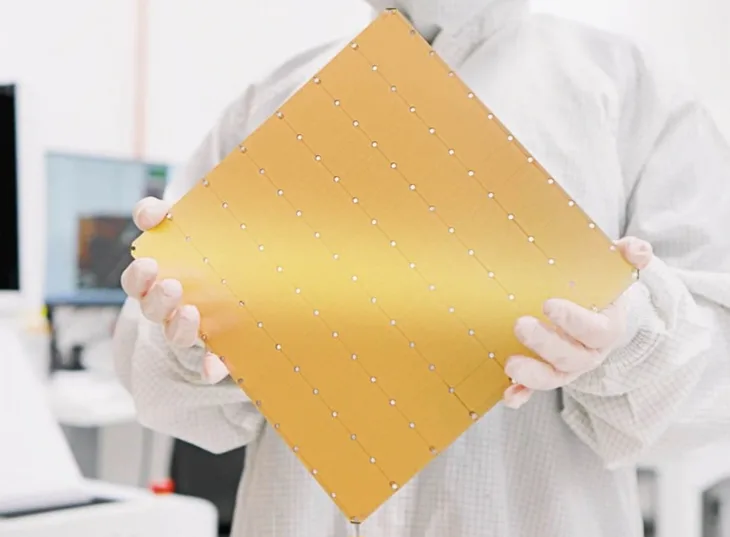
The second stage of AI, inference, or the creation stage, will take place on our devices (mobile phones, tablets), instead of in some far away data center, making fast, real-time processing power an absolute necessity.
One could even say processing power of “one thousand times the speed of regular artificial intelligence.”
After all, if AI is going to perform all the productive tasks it promises, such as advanced research, coding applications from scratch and debugging them, it is going to need all the processing speed it can get.
This requires a lighter weight, more agile processor than most of Nvidia’s CPUs and GPUs, which were built to do the heavy lifting required at the initial LLM training stage.
One “Accelerated AI” stock has developed the world’s most powerful processor for inference or “Golden Tablet,” and it’s going to help kickstart the biggest productivity boom in history.
Revealing Jeff Brown’s Accelerated AI Stock
Jeff calls it the “perfect tech stock” and this is what we know about it:
- This company’s patented technology is capable of processing at 120 trillion synapses or more than the human brain.
- Some of it’s customers include the likes of IBM and Microsoft, which has partnered with it to help it’s software engineering teams write code faster.
- It has a $25 billion backlog for its processing technology.
Jeff’s “Accelerated AI” Stock is Cerebras Systems Inc. (Nasdaq: CBRS). The clues stack up like AI hardware:
- Cerebras’ Wafer-Scale Engine processor chips can handle neural networks of up to 120 trillion parameters.
- It has had a long-term in-direct partnership in place with Microsoft, by enabling its subsidiary, Github, to generate code at top speed with Cerebras’ Code MCP server.
- As of the latest reporting quarter, Cerebras has a $25.4 billion backlog for its inference processor chips.
Triple Your Money Over The Next 24 Months?
History doesn’t repeat, but it does rhyme, and AI inference is about to bust out an MC rap.
Just like broadband internet picks and shovels plays made early investors rich and paved the way for the internet applications we use today, so too will inference enable the advanced AI apps of tomorrow.
At least this is the thesis.
The whole “one stock retirement” thing is just marketing clickbait, with Jeff admitting in the teaser video that he wouldn’t recommend moving the majority of your portfolio into one name.
However, given that the AI data center buildout is stalling due to a lack of energy and public nuisance, processing will have to move on-device.
The essential components needed to pull this off are:
- Processing, for performance
- Memory, for efficiency
- Storage, that doesn’t use up too much battery life
Cerebras addresses the first need with the world’s fastest AI processor, at an estimated 21x, not 1,000x, the speed of Nvidia’s flagship Blackwell B200 GPU.
That’s the good news.
The bad news is that building and iterating on high-speed wafer-scale technology is extremely capital intensive, making Cerebras unprofitable as a going concern.
Between chip development, production costs, and quality control, it lost $4.5 dollars for every $1.8 it made in Q2. Despite more than 100% year-over-year revenue growth.
It’s true that inference is still very much in its infancy, so much so that Cerebras’ forecast of tripling revenue in fiscal 2027 depends entirely on building out more than 600 megawatts of its own data-center capacity in order to make it happen.
Maybe it gets built, maybe it doesn’t, given the new energy reality and political climate.
Either way, Cerebras’ chips work in both cloud and on-device environments, making it a hedge against on-device inference (edge AI) arriving later rather sooner.
It’s balance sheet can see it through, with $8.5 billion in cash against only $1.5 billion in debt and around $400-$700 million in annual capital expenditures. So this isn’t the issue.
The issue is valuation, 65x current sales. Sure, it will come down over time with growth, but it will remain ‘elevated’ for a good while, to say the least.
Jeff’s is a short-term call, triple our money in the next two years. If Cerebras hits it’s forecasts for next year, there’s a chance, if not, it sinks like the Titanic.
Quick Recap & Conclusion
- Tech analyst Jeff Brown believes an “Accelerated AI Stock,” is the base for a one stock retirement plan.
- What Jeff calls “Accelerated AI” refers to AI inference, which is the next creation stage of artificial intelligence and it depends on fast, real-time processing power.
- Jeff’s pick supplies it and it’s name is only revealed in a new research report titled “The One Stock Retirement Plan.” We can get a copy with a subscription to Brownstone Research’s Near Future Report, which costs $179 per year (normally $499).
- We were able to reveal it right here for free! It’s Cerebras Systems Inc. (Nasdaq: CBRS).
- Cerebras’ ultra-fast chips work in both cloud and on-device environments, making it a hedged bet. The issue is it’s sky high valuation and whether it will square with the business’ reality over the next few years.
How soon will AI compute move on-device? Now, soon, far from soon, tell us in the comments.