The most profound technology of our time, artificial intelligence, has run into a major roadblock that threatens it’s progress.
It’s not chips or capital, but electricity, and a little-known energy project Dylan Jovine calls the “X-Grid” may just be the solution.
The Teaser
Washington considers the “X-Grid” so essential that interfering with it would be a threat to national security.
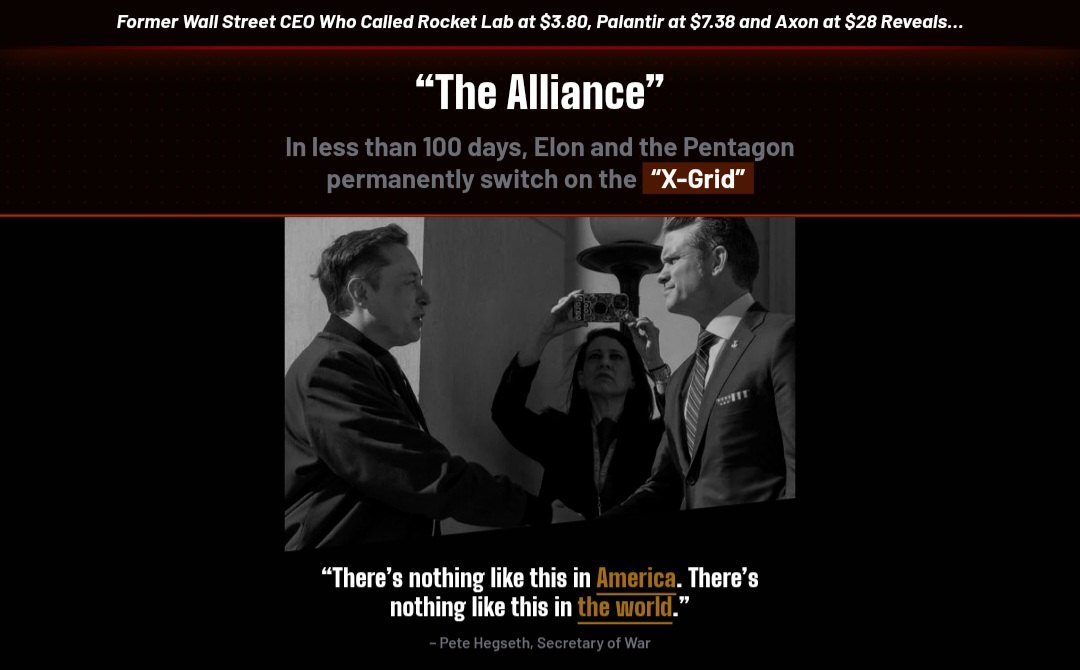
We’re familiar with Behind the Markets founder Dylan Jovine’s rags to Wall Street riches story and his most recent newsletter teasers, including his “Second Window” Moon Stock and “Shadow Miner” Company.
As with all things ‘X’ related, the “X-Grid” is connected to a man that has become synonymous with the letter, Elon Musk.
The man, myth, and legend that is Elon has a lot going on. From ‘flying cars’ to Colossus data centers, and space satellites.
Dylan cryptically says “Elon’s X-Grid will be permanently switched on” come December 11th.
This suggests it is related to Elon’s sprawling cluster of data centers that reach across two state lines dubbed Colossus, and more specifically what powers them.
Earlier this year, Cleanview, a firm that tracks America’s power plants, counted every data center in the country that generates its own power.
Of the 2 gigawatts (GW) that are actually up and running, xAI’s two Colossus sites account for 1.5 GW.
Behind-the-meter, private power plants are the “X-Grid.”
However, every single on-site power plant requires something called a gas turbine to operate and Elon Musk eloquently pointed out what the problem with this is:
The limiting factor for natural gas turbine production is casting the blades and vanes
So Elon did what he usually does when confronted with a difficult problem, he went about solving it himself, or tried to.
Not only has he purchased power generating equipment, but SpaceX is also building a foundry in Texas to cast its own gas turbine blades and vanes.
This is where our investment opportunity comes in, as Elon isn’t building the so-called “X-Grid” alone, with one small, publicly traded company locking-in a 7-year contract with Elon to build Colossus’ permanent, private power generation.
The Pitch
It’s name, ticker symbol, and buy-up-to price is revealed in a special report called “The X-Grid Windfall: America’s New Energy Titan.”
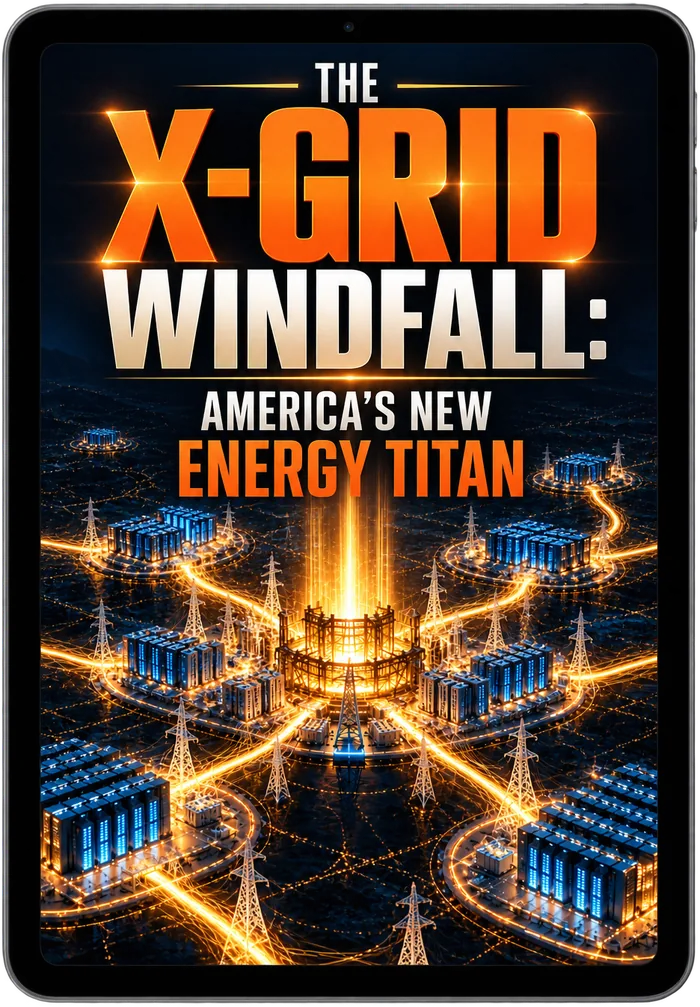
It, along with two more bonus reports, can be ours if we give Dylan’s Behind the Markets research service a try. Our cost would be $49 for the first year (normally $399) and it comes with a six-month money-back guarantee.
Why Behind-the-Meter Power Works
Nearly half of all announced U.S. data center projects delayed, a 7 GW shortage, and a seven-year queue.
The investment thesis being presented goes beyond one company’s private power plant.
It’s about who, what, and where power can be delivered in months, while others potentially wait years.
As of this past summer, somewhere between 30% and 50% of all U.S. data center projects planned for this year have either been canceled or delayed.
The primary reason? More than 75 projects and counting have been kibosh’ed due to growing local opposition, with state governors and city councils slamming the brakes. But the remainder have mostly fallen by the wayside due to power grid bottlenecks and electrical component shortages, as we already highlighted with gas turbines.
In some states, the connection wait time has reached seven whole years. Enough time to earn a PhD.
Against such a challenging backdrop, private, behind-the-meter power is one of the only ways to get a data center online now.
Skipping the Line
Elon claims behind-the-meter power cuts “up to 18 months” off a data center’s development time.
Even so, implementing it is far easier said than done.
Laws differ state by state, but in general, local utility regulations dictate what permits are necessary for installation and operation of behind-the-meter power.
However, the federal government has largely cleared the path for behind-the-meter power. The Environmental Protection Agency (EPA) exempts it from certain regulations and President Trump promoted it in a recent interview.
One company is already at the front of the line. It owns the turbines and has the crews to install and run them around the clock. Let’s find out what it is.
Revealing Dylan Jovine’s “X-Grid” AI Power Stock
Dylan revealed quite a bit about the company building behind-the-meter power for three different hyperscalers.
These were the most telling clues:
- It has locked-in a 7-year contract with xAI to build Colossus’ permanent power generation.
- A little over 10 years ago, it started out building equipment for the America’s shale drillers.
- This past summer it bought two more companies to bring even more construction work in-house.
Dylan’s “X-Grid” power stock is Solaris Energy Infrastructure, Inc. (NYSE: SEI). The clues connect like an on-site power plant.
- SEI’s Solaris Power Solutions subsidiary signed a joint venture agreement with xAI in 2025.
- The company was originally founded as Solaris Oilfield Infrastructure in 2014 and went public in 2017 before expanding into power solutions in 2024.
- In July and August, Solaris acquired engineering services firms Global Energy Services Alliance and Omega Foundation Services, respectively.
Make 1,000% over the next 12 Months?
This is about what Colossus is really for, the company helping make it a reality, and a near-term catalyst.
We now know Solaris is the company, but Colossus’ ultimate purpose and catalyst are intertwined.
Dylan explains that besides xAI and in turn SpaceX building an AI cloud business, the Pentagon is now relying on that cloud business, and could end up purchasing on-site power from it (and in-directly Solaris) for it’s prospective data center installations on military bases.
The near-term catalyst is December 11th, which is the that date the United States federal government is funded through under a short-term continuing resolution. After this, an appropriations bill could get passed, or more likely, yet another short-term funding bill, freeing up the Pentagon to allocate funds to new federal initiatives.
The setup is slightly convoluted, but overall, plausible.
However, Solaris’ underlying economics make Dylan’s entire thesis a mute point.
The “X-Grid” builder trades at a whopping earnings multiple of 69x, has a subpar return on equity (ROIC) of 8%, while carrying $2.6 billion in debt, against only $400 million in cash.
At such a price, there is no room for error, meaning any slowdown in data center builds, would weigh heavy on the business, and in turn the stock.
If Dylan’s near-term catalyst comes to fruition, the stock would get a short-term pop, especially after it’s recent sell-off. But there’s no basis for the value 10x’ing over the next year.
Quick Recap & Conclusion
- Behind the Markets founder Dylan Jovine is teasing a solution to AI’s biggest bottleneck and he calls it the “X-Grid.”
- “X-Grid” is code for behind-the-meter power plants, which could be the only way data center projects continue to get built, and one AI power stock has the equipment and expertise to operate them.
- It’s name is only revealed in a special report called “The X-Grid Windfall: America’s New Energy Titan.” A subscription to Dylan’s Behind the Markets research service is required to access it, which costs $49 for the first year (normally $399).
- We revealed the “X-Grid” builder for you for free, it’s Solaris Energy Infrastructure, Inc. (NYSE: SEI).
- Solaris is valued at a large premium, has below-average underlying economics, and a shaky catalyst for additional growth.
Would you support new data centers getting built if they paid for their own power grid? Tell us in the comments.