
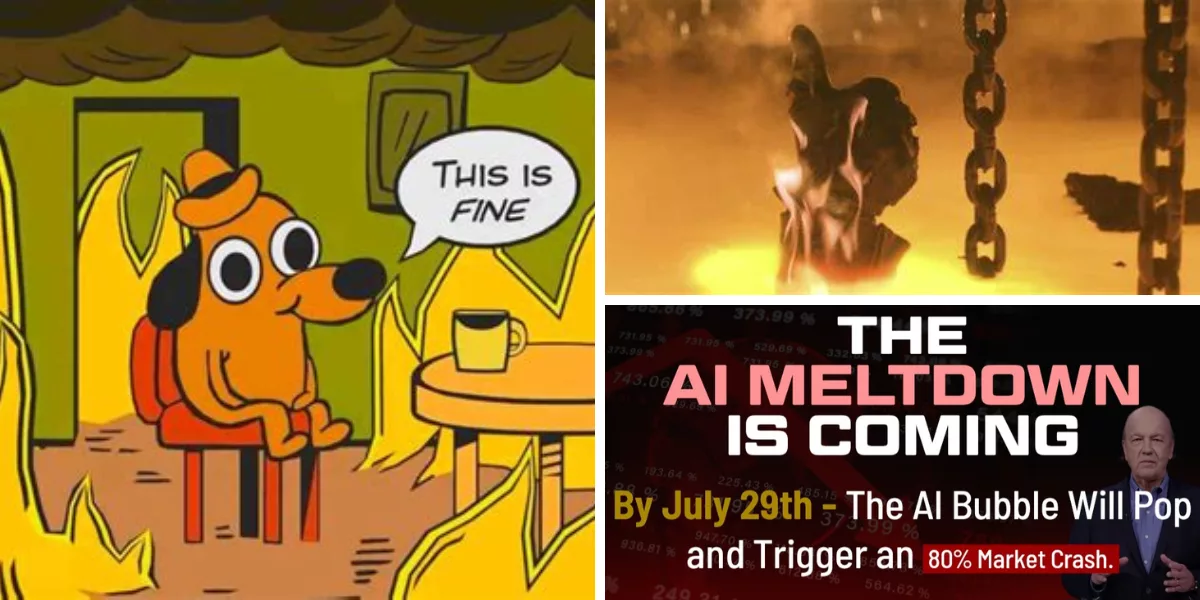
There’s one question on every investor’s mind, is AI a massive bubble that’s about to pop?
According to economist Jim Rickards, the answer is yes, and one of the only ways to protect our downside is with three “AI Meltdown Stocks.”
The Teaser
Jim’s research shows there’s a domino that will topple all the others, leading to a collapse that has quietly already started.
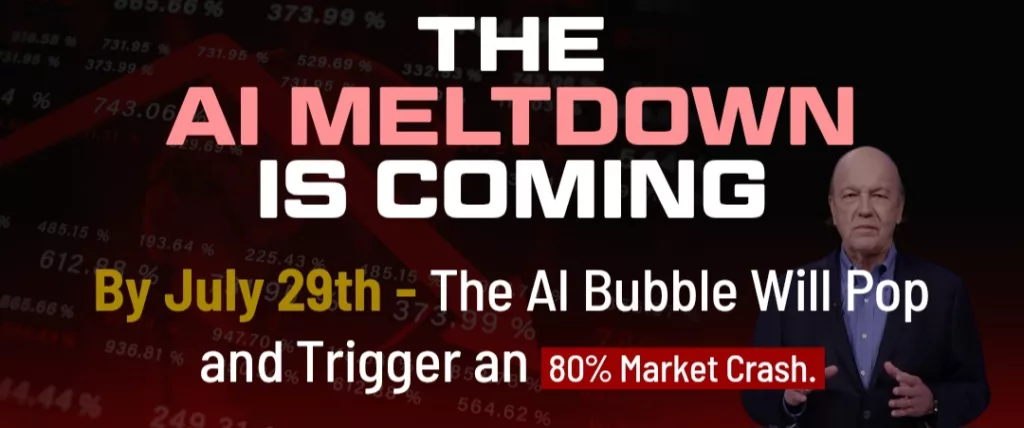
Long before editing investment newsletters, Jim Rickards was an economist and lawyer, infamously serving as general counsel for the ill-fated Long Term Capital Management (LTCM).
We have previously covered some of his previous teasers, including Trump’s Secret $2 Gold Mining Stocks and American Birthright Pitch.
The domino is so important that it has been called “ a pillar of the global economy.”
Jim believes believe that pillar is about to collapse and once it does…
It will set off a series of cascading failures, bringing the entire AI industry down with it
Once the dust and debris settle, we could be looking at an 80% crash that would gut millions of Americans.
This wouldn’t be entirely unprecedented, as the Nasdaq crattered by 78% from it’s record high in March 2000 to October 2002 during the dot-com bubble.
Jim continues, saying that “just as Lehman Brothers had connections to all banks on Wall Street in 2018, this company is linked at the hip to all the big players in the AI space.” In 2025 alone, it signed a staggering $1.4 trillion worth of deals with other major AI companies.
The ‘pillar’ Jim is talking about here is OpenAI.
Just three years after forcing the 800-pound silverback gorilla of search, Google, to declare a “code red” emergency following the launch of it’s massively popular generative AI chatbot, ChatGPT. It has had to take a knee and declare a “code red” of its own.
The reason for this is that internally, there is growing fear that Google’s latest Gemini model has surpassed ChatGPT on every benchmark test, while also signifcantly growing it’s user base.
OpenAI could be the canary in the AI bubble coal mine, but there are ways we can still win even in a bust scenario.
The Pitch
We can find the names, ticker symbols, and Jim’s full analysis inside a report called Three Bubble-Proof Stocks Set to Skyrocket in 2026.

The report is a package deal with a subscription to Jim’s flagship research service, Strategic Intelligence.
It costs $49 upfront for the first six months (normally $299) and comes with a 90-day, no questions asked, money-back guarantee.
10x Worse Than Lehman Brothers?
Animal spirits.
The 2009 book by the same title argued that human emotions, such as fear, euphoria, and herd behavior primarily drive markets rather than cool, calm, rational economic calculations.
That is, nobody can resist the dream of getting rich from a revolutionary technology that “everyone knows” will change the world.
If we stop and look around today, the signs are all around us, starting with the very same accounting practices used by Lehman Brothers in the run up to the 2008 financial crisis.
The Special Purpose Vehicle
Meta recently raised about $30 billion to build a new data center in Louisiana.
However, this new debt will not show up anywhere on it’s balance sheet. Instead, it’s held by a separate legal entity, known as a special-purpose vehicle (SPV).
Most commonly used in real estate and bank finance to house single properties and secruitized debt, SPVs have been co-opted to hide debt off-balance sheet.
This is exactly how financial institutions, like Lehman, used SPVs to obfuscate billions of dollars in debt leading up to 2008. Investors had no idea how much risk they were truly carrying.
Today, private credit loans outstanding to AI-related companies already exceed $200 billion by some estimates.
Add in trillions more in circular financing deals, an S&P price/earnings ratio that is well above the median:
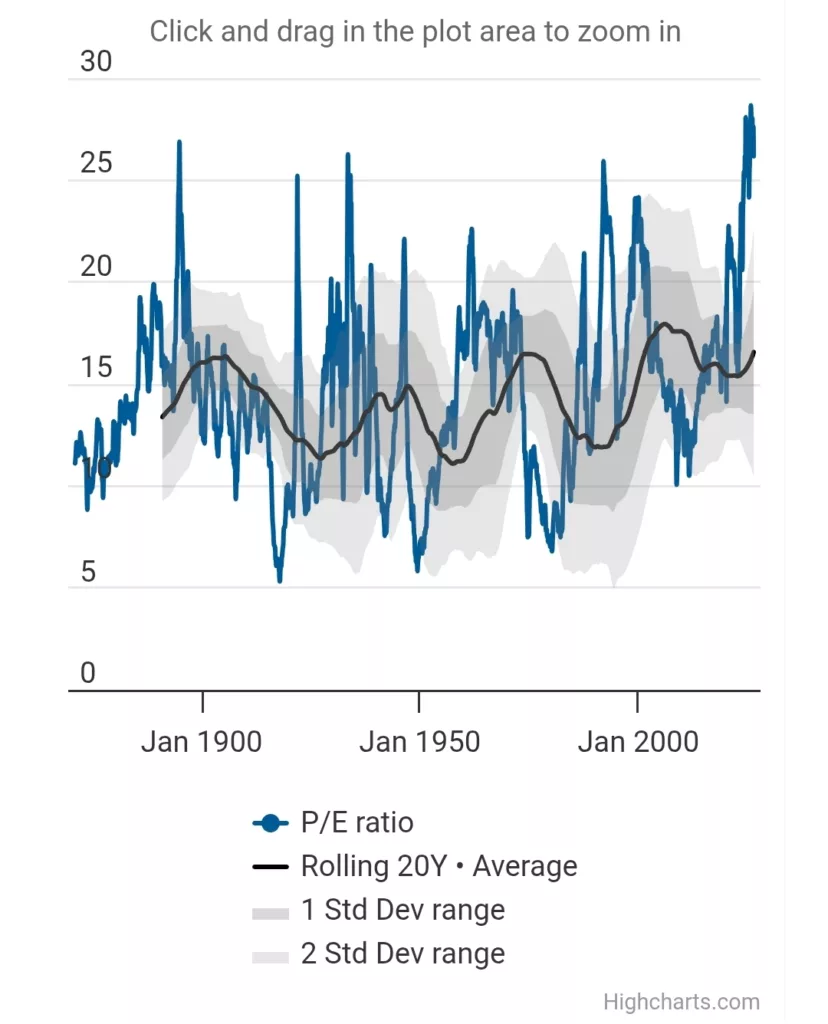
And you have a perfectly delicious recipe for distaster.
Jim has circled July 29th on the calendar as the potential day of reckoning, which also happens to be when Microsoft (OpenAI’s biggest financial backer) is expected to release its fiscal 2026 Q4 earnings report.
This means there may not be much time left to prepare, so let’s find out what Jim’s picks to survive the upcoming AI meltdown are.
Revealing Jim Rickard’s AI Meltdown Stocks
As bad as things could get, there’s a group of stocks that will be immune to this AI meltdown.
Jim is talking about three “bubble-proof” picks, starting with his favorite gold royalty stock.
First Meltdown Stock
- It’s a little-known company that already has gold and silver royalty deals with more than 200 different mines and exploration projects.
- It beat physical gold’s performance in 2025.
This could be Gold Royalty Corp. (NYSE: GROY), which owns a portfolio of more than 250 royalties and streams in mainly gold and silver exploration and development assets.
Second Meltdown Stock
- This little-known investment is designed to go up when tech stocks go down.
Jim is talking about an inverse technology ETF and the most popular one by volume is ProShares Short QQQ (NYSE: PSQ), which goes up when the tech-heavy Nasdaq-100 index goes down.
Third Meltdown Stock
- This company has increased its dividends for the past 36 years.
- Berkshire Hathaway has invested more than $18 billion into this stock.
Chevron Corp. (NYSE: CVX) is the name that consistently came up for me. It has increased its dividend for the past 38 years and Berkshire owns a stake worth nearly $18 billion, making it the company’s fifth largest holding.
The Best Ways to Play the AI Bust?
Railroads, radio, the internet…
All innovations that changed the world, all booms and subsequent busts.
Artificial intelligence is more likely than not to follow in it’s ancestors footsteps. However, I disagree slightly about the timing.
The first wave of SPV debt won’t come due until 2027-2028, which is when some refinancings or outright defaults could start to take place, leading to a potential meltdown of expectations and in turn, valuations.
Of course, I could be totally off and it may have already happened with the largest IPO in history, SpaceX, and the stock’s shaky start.
But irrespective of the timing of a potential AI meltdown, how likely are Jim’s picks to hold up?
Gold Royalty Corp: Doesn’t pay a dividend, which kind of defeats the purpose of a royalty play.
Short QQQ: A timing play with a high opportunity cost.
Chevron: A bit more debt than I would normally like to see with a current ratio only slightly above 1.0, but it is the pick that is most likely to weather a potential AI meltdown the best, given it’s diversified operations and current price of just under 2x book value.
However, the best downside protection of all still remains hard assets, physical metals, a lack of leverage, and liquidity.
Quick Recap & Conclusion
- According to economist Jim Rickards, the AI bubble is about to pop, and one of the only ways to protect our downside is with three “AI Meltdown Stocks.”
- Jim draws damning parallels between today’s circular financing deals to those pre-dating the dot com crash and off-balance sheet special purpose vehicle debt to the same leading up to the 2008 financial crisis.
- We can find the names of Jim’s top picks to ride out a potential AI meltdown inside a report called Three Bubble-Proof Stocks Set to Skyrocket in 2026. It requires a subscription to the Strategic Intelligence research service, which costs $49 for the first six months (normally $299).
- Clues were thinner than AI company profit margins, but we were able to reveal some, if not all, of Jim’s AI Meltdown Stocks for free as Gold Royalty Corp. (NYSE: GROY), ProShares Short QQQ (NYSE: PSQ), and Chevron Corp. (NYSE: CVX).
- Chevron is the pick most likely to withstand a meltdown the best, given it’s massively diversified operations and moderate valuation.
When will the AI meltdown take place? Leave your best guess in the comments.
Thanks great as usual
As always, thank you so much for your valuable insight and explanation.
Thank you for your efforts and insight. It is appreciated.