
Centuries-old industries meet distruptive new technology.
It’s a familiar theme that has made many investors wealthy and SMX is hoping it’s proprietary technology that digitizes physical objects will do the same.
From a Linear to a Circular Economy
Take-make-dispose.
This is what has made the world economy go round since at least the 20th century.
However, some are of the belief that there is a better, more sustainable way of doing things than buying products, using them, and then discarding them.
The reasoning goes like this…we’re extracting raw materials and their inputs faster than they can be replenished. At the same time, waste generation is also seen as growing at an unsustainable pace.
A more circular model of take-reuse/make-recycle is seen as the solution by many bureaucrats, policymakers, and pundits alike.
Details about how such a model would work in practice differ depending on who you ask, from removing waste at the design stage, rather than capturing it downstream to economic levies (taxes) on ‘wasteful’ materials like plastic. The European Union and other nations are currently piloting various circular economic initiatives as I type this.
It’s too early to tell what solution, if any, will end up becoming the standard. But one Dublin, Ireland-based company wants to use technology to help facilitate a more transparent circular economy.
What is SMX?
Security Matters Public Limited Company (Nasdaq: SMX) is for all intents and purposes an Israeli government spin-off.
The business was incorporated all the way back in 2014 to commercialize Source IP technology.
We have previously reviewed other direct company pitches, such as EnergyX and Med-X, among others.
Source IP is a track and trace technology originally developed for the anti-counterfeit market by the Israeli Atomic Energy Commission’s (Soreq) Nuclear Research Center.
In January 2015, SMX, which was founded by Haggai Alon, a veteran of the Israeli Ministry of Defense, conveniently entered into a sweetheart licensing agreement with Isorad Ltd., the IP holding company of Soreq, to commercialize the technology.
Per SMX’s most recent securities offering prospectus:
The licensing agreements allows Source IP to be utilized in almost any industry, with any product
Taking a diversified approach is exactly what Alon has done as CEO.
The company has created a number of operating subsidiaries to apply Source IP to different verticals:
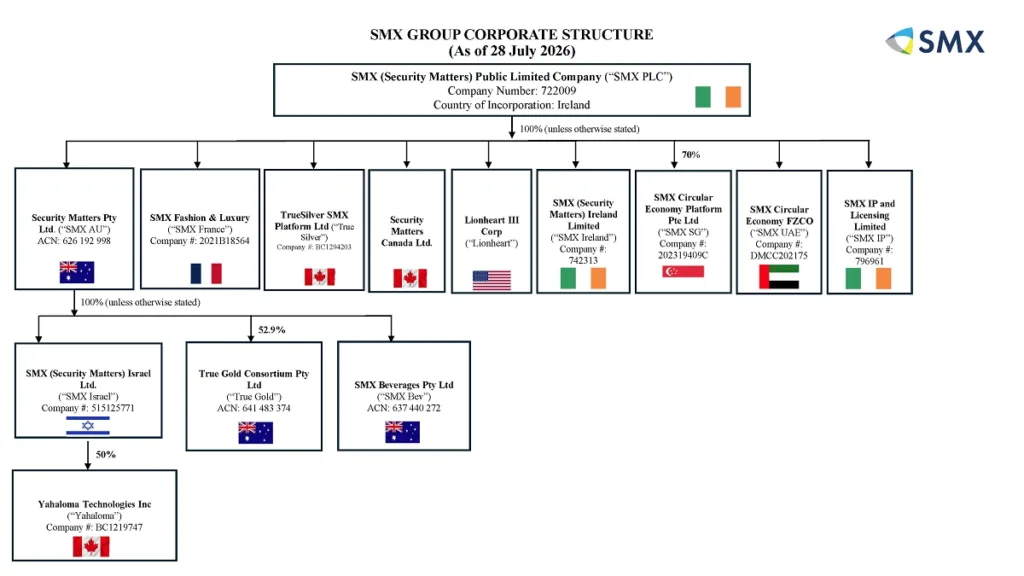
Now, following a string of business combinations, a reincorporation, and most recently, a reverse merger with a Special Purpose Acquisition Corp. (SPAC) in early 2023 to go public, SMX may finally be ready to lead the shift to what it calls “verified circularity.”
What Does SMX Actually Do?
SMX calls itself “the global supply chain’s missing link.”
Buzzwords aside, the company is out to solve a structural flaw inherent in every supply chain – materials lose their identity the moment they are processed.
Origin becomes unverifiable, paperwork is inconsistent, and recycled content is anyone’s guess.
SMX has developed an identity platform to solve such pervasive issues and it’s made up of three components:
- A physical or chemical marker system
- A reader, which is connected to
- A blockchain platform
The markers are sub-molecular particles embedded directly into material that can be read by designated readers, such as SMX’s hand-held x-ray wave readers.
Finally, it all comes together with an algorithm connecting the readers to an existing blockchain platform (licensed from a third-party SaaS provider) that immutably records changing ownership and other product information directly on the blockchain.
With this, supply chains become measurable, circularity becomes actionable, and compliance is automatic.
Parts of SMX’s marking tech as well as it’s systems and processes are proprietary and protected by more than 100 patent filings around the world.
The potential customer pool is wide, any business that makes and needs to transport a physical product, but SMX is starting at the source. It is targeting raw material producers initially, followed by textile, plastic, and electronics manufacturers as well as critical mineral suppliers over time.
So we now know SMX is attempting to solve a real problem with a tangible solution, question is, how good has it been at executing it’s strategic plan?
Is SMX a Good Investment?
A good business isn’t necessarily a good investment, it depends on the price we pay for it.
This is a universal truth like cats and goldfish not getting along.
To this end, SMX has filed a prospectus to issue 25,414,300 common shares from treasury at the prevailing market price (around $16-17 per share), which is the reason for all of the recent adverts we have been seeing about it.
Assuming a steady stock price, this would give SMX a post-issuance market value of nearly $43 million.
Is this good, bad, or somewhere in between?
When it comes to SMX, it is terrible.
I don’t just say this because the dilution is historic, which it is.
The business currently has 1,088,608 total shares outstanding. So management is going to issue 23x this amount in one fell swoop.
However, one line from SMX’s June operating results is even more damning:
The company has not yet generated recurring revenue from commercial technology deployments
Moreover, it has incurred losses and generated negative cash flow from operations ever since inception, amounting to some $251 million in total.
What it does have is commercial pilots with various industrial customers on an international basis. But despite this and declarations of “demonstrated 100% success rates,” when it comes to being able to verify markers embedded into products, these have not translated into commercial deployments.
This tells us that either some part of the molecular identity platform does not work as advertised or more worrisome, that there is no market for circular verification tech.
In the end, all we get from SMX are operating loss carryforwards and process patent applications at various stages of approval.
The net operating loss carryforwards are valuable, but only to someone acquiring control (50% or more of the shares.) As passive, individual investors, buying SMX even at the currently prevailing market cap of $18 million is not a good investment.
Quick Recap & Conclusion
- Publicly-traded Security Matters Public Limited Company (Nasdaq: SMX) has filed a prospectus for a brand new share offering, which it has been heavily promoting.
- The company has developed a proprietary molecular identity platform that embeds permanent, tamper-proof verification inside materials themselves, enabling auditable tracking across the entire supply chain.
- SMX is issuing 25,414,300 common shares from treasury at today’s prevailing market price (around $16-17 per share).
- Besides the issuance basically wiping out existing shareholders, as it increases the number of shares outstanding by 23x, SMX has yet to generate recurring revenue on any level and it is not a good investment at its current market cap of $18 million.
Is the circular economy concept practicable? We would love to hear your thoughts in the comments.