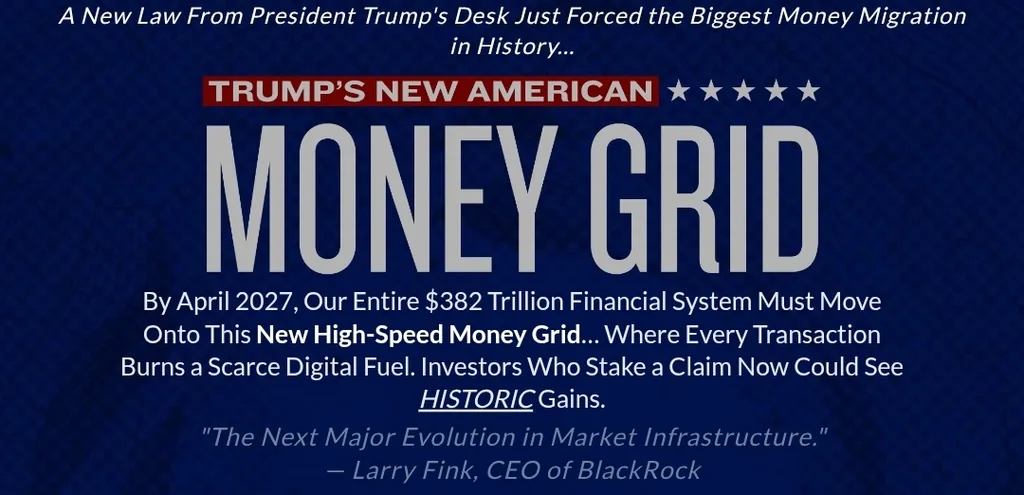
Host Chuck Adams and Andy Howard make the bold claim that every single financial asset will be moved onto President Trump’s “New American Money Grid” by April 2027.
It could create the most explosive investment opportunity of our lifetime and one “Digital Oil” Stock is set up for major gains.
The Teaser
The biggest change to market infrastructure in half-a-century.
Andy Howard is a bit of an enigma in the investment newsletter space.
A computer scientist by profession, who compounded his own capital into a seven-figure investment portfolio in the span of only a few short years. We have previously reviewed his Automatic Payment Pools teaser as well as Trump-themed presentations from a host of others.
This one is about the plumbing underneath our financial system, which Andy describes as “a set of clunky old pipes that haven’t changed since the 70s.”
It’s why money transfers aren’t instant and checks still take days to clear.
Andy has a point, for the average person not much has changed since the National Association of Securities Dealers (NASDAQ) began electronic stock trading in 1971 and checks still take two business days to clear on average.
Trump’s “New American Money Grid” is out to permanently change this.
In Andy’s words:
It’s always on, can’t be hacked, and faster than our current plumbing in every way
He’s talking about tokenization.
This is the process of recording financial asset ownership on digital ledgers (blockchain), enabling faster, more secure transaction settlement.
It’s a big deal as it affects the entire $400 trillion global financial market, real estate, credit, equities, everything. BlackRock head honcho Larry Fink has called tokenization “the next major evolution in market infrastructure.”
Similar to the real economy where physical goods need to be transported in order to arrive at their end destination, every single tokenized transaction burns a scarce “digital oil” that we can own.
The Pitch
What to buy, it’s ticker, and more are revealed only in a new report called “Digital Oil: The Scarce Digital Fuel Powering America’s New Money Grid.”
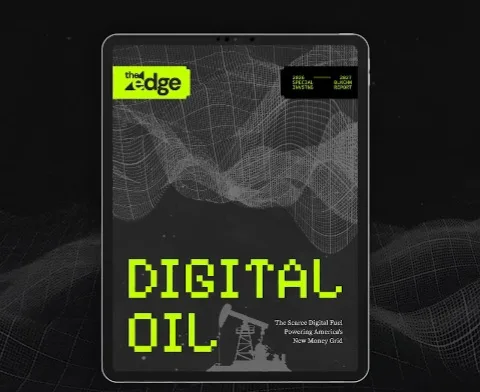
The report is ours, but only if we take Andy’s digital investment newsletter The Edge for a 60-day test drive, at a cost of $179 for the first year.
What in the World is “Digital Oil?”
By law, nearly $400 trillion in financial assets must be tokenized onto the new American money grid by April 2027.
The law is The Digital Asset Market Clarity Act, which aims to establish a clear cut regulatory framework for digital assets, including tokenized securities.
It passed a House vote and got the stamp of approval from the Senate Banking Committee, but the big bank lobby is actively trying to squash it due to a provision allowing stablecoin issuers to grant holders yield on their deposits. Competition is a no-no for the money center banks.
This scuttles Andy’s near-term catalyst, but his thesis is still very much in place and accelerating.
Year-to-date through July, tokenized assets have grown 360%, while tokenized trading is itself up over 100% on a monthly basis according to the largest tokenized asset trading platform, Jupiter.
JP Morgan is already running a tokenization service for it’s institutional clients and BlackRock launched a fund that invests in tokenization infrastructure.
Andy likens tokenization’s meteoric rise to the oil boom of the ’70s, the uranium surge of the 2000s, and the rare earth explosion of 2010. Each of these produced gains of as much as 1,233%, 400%, and 2,500% on the rare earth mineral dysprosium from through to peak, which is an oddly specific data point.
Now, tokenization is still very much in the early stages, but it’s massive scale dwarfs all three of these previous booms combined, and the crunch is in the finite “digital oil” burned on every tokenized transaction.
These are gas fees, which are the blockchain version of today’s processing fees, and as tokenized transaction volumes increase over time, so too can our money if we position it right.
Andy Howard’s “Digital Oil” Stock
All we know about Andy’s main pick is that it’s a “scarce asset powering Trump’s New American Money Grid.”
No clues, hints, or elaborations.
Nonetheless, we will take a shot at this given what little we do know.
If we follow the logic, tokenization is powered by blockchain technology and the blockchain that is the settlement layer for most tokenized transactions today is Ethereum (ETH).*
Although it’s not a stock and ETH has no fixed supply like Bitcoin, it’s base fee for every transaction is burned, meaning the more transactions there are, the more it’s actual supply decreases.
Beyond this, Andy also teases a few more picks in the bonus reports that accompany a subscription to his blockchain-focused monthly newsletter.
The Eyes and Ears of the New Money Grid
- A blockchain oracle/data feed project that JPMorgan, Franklin Templeton, and BNY Mellon are already plugged into.
This sounds like Chainlink (LINK).*
- Chainlink provides real-world data feeds for tokenization and other blockchain applications and the The Depository Trust and Clearing Corporation (DTCC), whose member firms include JPMorgan, Franklin Templeton, and BNY Mellon, piloted a project called Smart NAV on Chainlink.
The Digital “Bank” That Never Closes
- This blockchain lending platform has $50B in deposits; 50% growth in three months, and no manual approval process.
Aave (AAVE) is the blockchain lending protocol that surpassed $50 billion in crypto deposits last year. All of it’s lending is also completely automated and self-executing via smart contracts.
#1 Play at the AI/Blockchain Intersection
- It’s a decentralized AI platform with 120 AI systems already plugged into it.
Andy could be talking about DGrid AI (DGAI), which is a decentralized AI inference network providing direct access to large language models (LLMs) from more than 120 providers (200+ at last count).
Historic Gains from the New American Money Grid?
All the facts and figures show that tokenization is on the rise.
Much like refined oil, which Andy likens it to, if tokenization and the blockchain become the world’s new financial rails, retail adoption will be assured, and the investment opportunity will turn out to be a multi-trillion dollar bonanza.
I agree that picks and shovels and the base layer infrastructure is the way to play tokenization at this initial stage.
The key is to own scarce, hard to duplicate assets regardless of which blockchain or retail distribution platform wins in the end.
To this end, Chainlink* for data, Quant (QNT) for interoperability, and Circle (NYSE: CRCL) for dollar deposits are about as neutral and opportunistic as it gets.
If only a small percentage of the $50 trillion in annual U.S. financial transactions move on-chain, the gains will indeed be historic.
Quick Recap & Conclusion
- Andy Howard makes the bold claim that every single financial asset will be moved onto a “New American Money Grid” and one “Digital Oil” Stock is set up for disproportionate gains.
- The “New American Money Grid” is the blockchain and the “Digital Oil” fueling it is tokenization.
- Andy’s top recommendation to play this new financial reality is only revealed in a new report called “Digital Oil: The Scarce Digital Fuel Powering America’s New Money Grid.” It’s ours, but only if we take Andy’s digital investment newsletter The Edge for a 60-day test drive, at a cost of $179 for the first year.
- Clues were nonexistent, but Andy’s “digital oil” sounds an awful lot like Ethereum (ETH)* and we also attempted to reveal three more bonus picks.
- Picks and shovels and the base layer infrastructure is the best way to play tokenization at this early stage.
Will the blockchain and tokenization replace the current financial system? Tell us what you think in the comments.
*The author owns Ethereum (ETH) and Chainlink (LINK) coins.