
Why Contrarian Investing Works Best When It Meets Value
A lot of people hear contrarian investing and think it just means buying whatever everyone else hates.
That’s too simple.
Plenty of things are out of favor for a good reason. Some sectors are cheap because they’re broken. Some companies are ignored because they deserve to be. And some “contrarian” ideas stay contrarian forever… which is another way of saying they just keep going nowhere.
So no.. just being a contrarian isn’t enough.
The real edge comes when a contrarian idea also has value behind it.
That means it’s not just unpopular…
It’s unpopular and cheap.
Unpopular and still useful.
Unpopular and tied to something the world still actually needs.
That’s where things start to get interesting.
What contrarian investing actually is
In simple terms, contrarian investing means looking where other investors don’t want to look.
That could mean:
- sectors that are politically unpopular
- industries the mainstream media has written off
- markets that have been starved of capital
- or just areas that are too boring and unsexy for most investors to care about
Think the opposite of AI and Nvidia with their CEO Jensen Huang being treated like a rockstar.

Sometimes being contrarian and the polar opposite of Nvidia alone can lead to very good opportunities.
But only if the crowd is wrong for the right reasons.
This is the key.
Because not everything the crowd hates is a bargain.
Sometimes the crowd hates something because it’s genuinely in decline.
Why contrarian investing alone isn’t enough
This is where a lot of people get it wrong.
They think:
“Well, if everyone hates it, maybe that means it’s cheap.”
Maybe.
But maybe it just sucks.
That’s the problem.
If you go around buying whatever looks ugly, you’re going to end up with a portfolio full of junk.
The better question is not:
“What does everyone hate right now?”
It’s:
“What does everyone hate right now that still has real value underneath?”
That’s a much harder question to answer, yet essential if you want to profit from this style of investing.
Because the best contrarian ideas usually aren’t just hated.
They’re hated and mispriced due to this lack of investment.
The missing ingredient: value
This is why I think contrarian investing works best when it meets value.
Not just “different.”
Not just “unpopular.”
Not just “against the crowd.”
Cheap.
Neglected.
Still needed.
This is a much better setup.
If something is already expensive, heavily loved, and crowded with investors, where’s the asymmetry?
Sure, it can still go higher.
But a lot of the easy money has probably already been made.
On the other hand, when something is:
- underowned
- underfollowed
- underfunded
- and priced like nobody wants it
…then you at least have a real starting point.
Especially if the underlying business or sector still matters.
The “still needed” filter
This is probably the most important filter of all.
A contrarian idea gets much more interesting when it’s tied to something the world still needs.
That’s why sectors like uranium became interesting to some investors long before they became respectable again.
Take Cameco, the largest publicly-traded uranium company, for example:
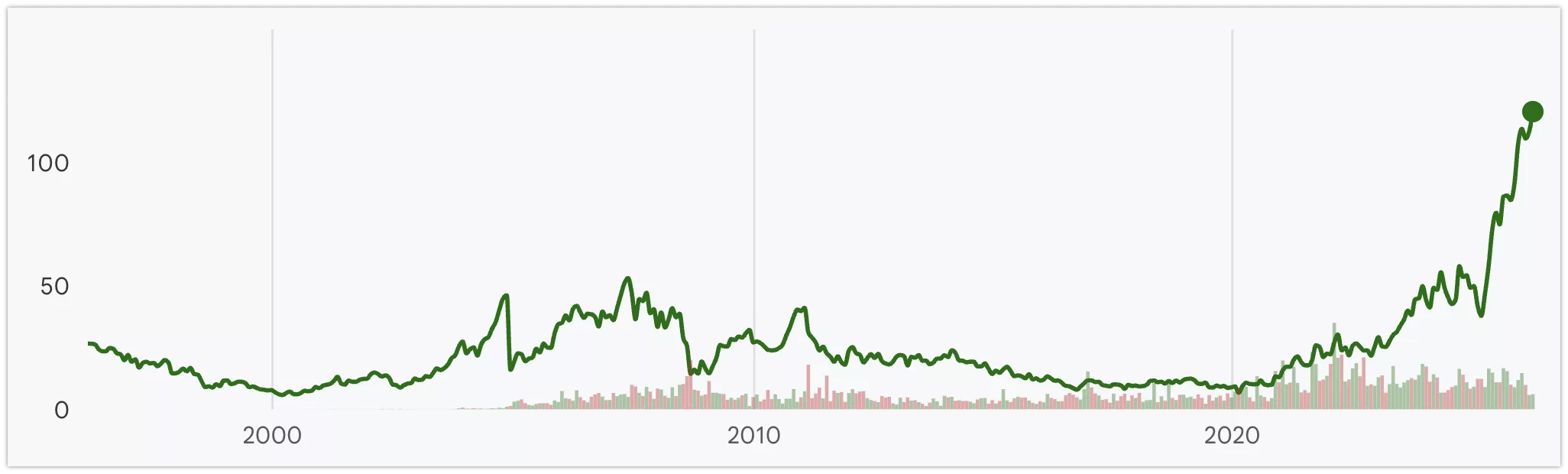
For years, it was treated like something smart, modern investors were supposed to avoid. In large parts of the market, they were politically awkward, culturally uncool, and easy to dismiss.
In a perfect world, maybe we could meet all our energy needs with wind and solar, but the sun doesn’t always shine and the wind doesn’t always blow.. so a reliable baseload energy is needed. Nuclear with its uranium, being cleaner than coal, is what the western world has now decided to run with.
The underlying need never disappeared.
The world will always need reliable energy.
That doesn’t mean every uranium-type investment is automatically a good one. Of course not.
But it does mean those sectors had a much stronger contrarian case than a lot of people realized.. because they weren’t just hated.
They were hated while still being necessary.
That’s a big difference.
A better contrarian example: shipping
But I think an even better example is shipping.
Because shipping isn’t really one of those sectors that people obsess over politically.
It’s just… not all that sexy.

Nobody’s getting on CNBC to hype up tanker stocks as the next big thing.
Nobody’s bragging to their friends about their amazing shipping thesis.
And that’s part of what makes it interesting.
Shipping is one of those industries the global economy absolutely depends on, but most investors barely think about unless something goes wrong. Oil still has to move. Refined products still have to move. Bulk commodities still have to move. Global trade does not function on hype.
And what makes shipping interesting from a contrarian/value perspective is not just that it’s boring.
It’s that supply responds very slowly.
That matters a lot.
UNCTAD notes that shipping capacity is inelastic in the short term because it takes several years to build new ships. That time lag is a big deal. In plenty of industries, high prices attract new supply fairly quickly. In shipping, not so much.
If too many vessels were scrapped in a weak market, or owners held back on ordering because sentiment was poor, you can end up with a setup where demand is still there but supply can’t ramp fast enough when conditions improve.
And shipyard constraints make that even more interesting.
Seatrade reported that container-ship delivery slots had already been pushed to 2029 in 2024, and later said orderbooks stretched to 2030, far beyond the more typical roughly two-year build period after an order is placed. Even though those reports were on the container side, the broader point applies: when yards are full and lead times stretch out, shipping supply simply cannot adjust overnight.
That’s the sort of thing most casual investors never think about.
They look at a dull industry and move on.
But if you have an essential sector, depressed sentiment, constrained supply, long replacement times, and companies still trading at unexciting valuations, that can become a very different story.
That’s what makes shipping a better contrarian example than just “buying whatever people dislike.”
It’s not merely unpopular.
It’s unpopular while still tied to hard economic reality.
And if the market is still psychologically scarred from the last cycle (bankruptcies, overbuilding, ugly freight-rate collapses).. that can keep valuations subdued longer than the fundamentals justify.
That’s where the opportunity can come from.
Not from excitement.
From neglect.
This is one reason I find the Insider Newsletter interesting. They tend to focus on exactly these kinds of setups… sectors that are still economically important, still out of favor, and still trading at valuations that don’t fully reflect the underlying reality.
Why “boring” can beat “exciting”
The market loves excitement.
It loves narratives.
It loves AI booms.
It loves disruption.
It loves whatever feels like the future.
And again, sometimes that works.
But when everyone is already obsessed with a story, the valuation usually knows that too.
That’s why some of the best opportunities don’t come from buying whatever is hottest.
They come from buying what still matters while everyone else is distracted.
The stuff that looks too dull.
Too old-school.
Too unfashionable.
Too early.
Too uncomfortable.
Not because boring is automatically good.
But because boring, necessary, and undervalued can be a very powerful combination.
What to actually look for
If you want to approach contrarian investing intelligently, I think there are a few better questions to ask:
1. Is this hated for emotional reasons or economic reasons?
Those are not the same thing.
2. Is it actually cheap?
Not just down a lot. Not just ugly on a chart. Actually cheap relative to reality.
3. Does it still serve a necessary function?
If the world still needs it, the story may be far from over.
4. Has capital left too aggressively?
Sometimes the opportunity comes from underinvestment itself.
5. What would have to happen for sentiment to reverse?
It doesn’t need to become everyone’s favorite. It just needs the market to be less wrong.
That’s a much better framework than simply buying whatever feels uncomfortable.
Final thought
This is one reason I tend to find certain research services more interesting than others.
The better ones are not just “contrarian” for the sake of sounding clever. They combine contrarian thinking with value, patience, and a focus on sectors that still make economic sense even when the crowd wants nothing to do with them.
That’s a big part of what makes the Insider Newsletter interesting to me.
Not because it promises magic.
But because it’s built around a style of investing that actually makes sense: look where others won’t, make sure the value is there, and focus on sectors the world still can’t do without.
If that approach sounds interesting to you, I wrote a full review of the Insider Newsletter here.